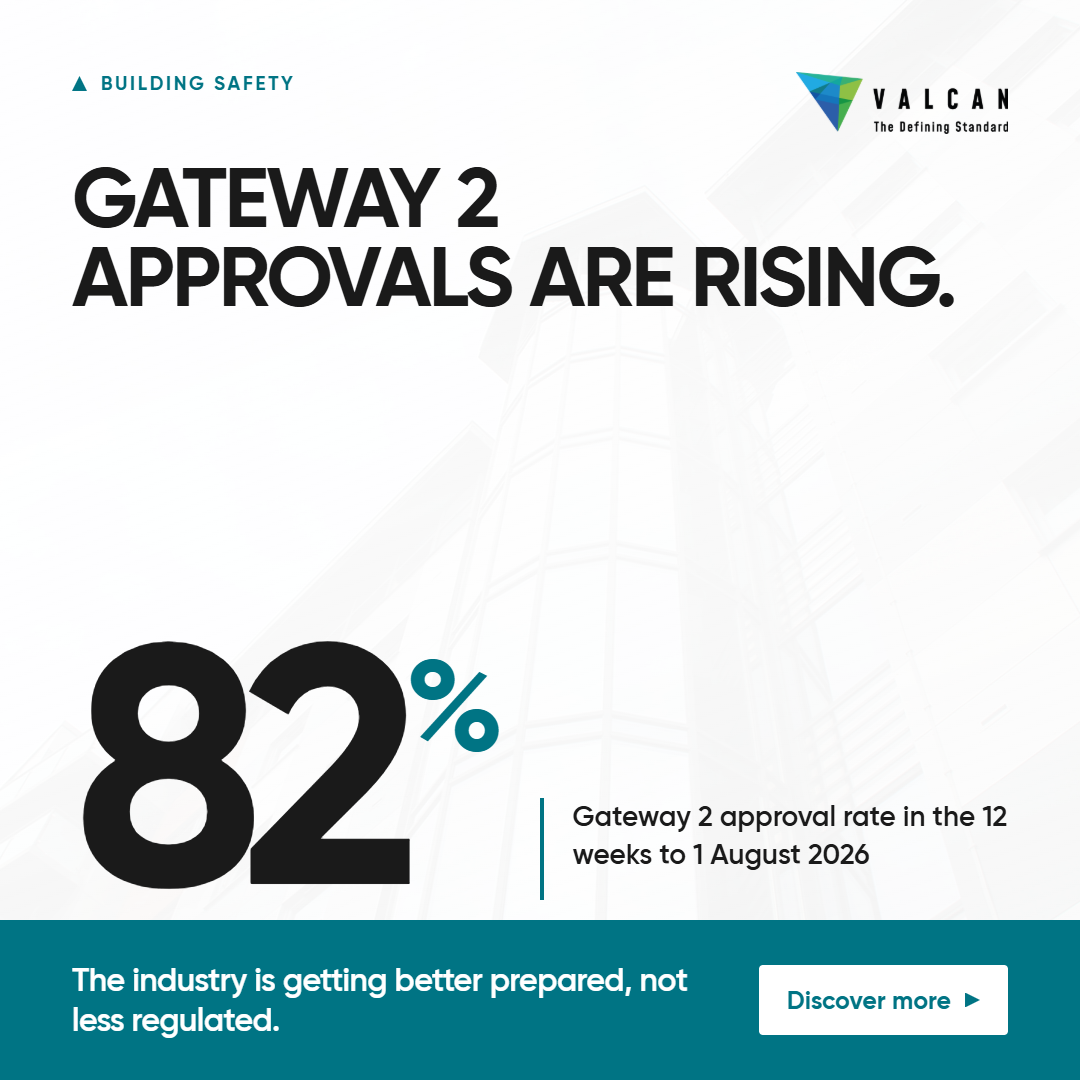
For the first time since the Building Safety Regulator (BSR) took on its Gateway 2 role, the numbers are moving decisively in the right direction. In the 12 weeks to 1 August 2026, the BSR approved 82% of Gateway 2 submissions. New build and conversion applications achieved a 91% approval rate nationally (93% in London), with median determination times falling to 22 weeks from 43 weeks a year earlier.
For an industry that spent the best part of three years describing Gateway 2 as a bottleneck, that's a significant shift. But look past the headline figures and the more interesting story is where that improvement is concentrated, and what it tells specifiers, contractors and building owners about how to get through the gateway first time.
Remediation is moving faster than anything else
External remediation approvals are running at 85% nationally and 92% in London, comfortably ahead of the BSR's own 65% target. There are currently 330 live remediation cases in the system, covering 28,778 units, compared with 131 live new build cases covering 30,421 units. In other words, remediation now accounts for most live Gateway 2 activity, and it is clearing the system faster than new build.
Set against that is a quieter, less encouraging statistic. Internal refurbishment cases, work that changes a building's internal arrangement rather than its external envelope, are still approved at only 77%, with a 32-week median determination period and 981 live cases. That's the slowest-moving Gateway 2 category and, at around 49% of all decisions, also the largest by volume.
The gap between the fastest and slowest categories is now wider than the gap between approved and not approved applications used to be.
The market underneath is contracting, not growing
These figures should also be viewed against a slowing construction market. While Gateway 2 approvals are improving, new work and project pipelines have weakened. As a result, remediation and recladding activity are likely to account for an increasingly large share of façade specification activity in the near term.
Why the gap between categories exists
The BSR does not publish a detailed breakdown of why some categories move faster than others, but the pattern is consistent with what specifiers and approving officers have been saying since Gateway 2 launched: applications succeed first time when the supporting evidence is complete, current and easy to verify.
A submission built around a façade system with up-to-date fire classification reports, a current Declaration of Performance, third-party certification and clear installation guidance is less likely to require multiple rounds of clarification. One built around incomplete or outdated documentation is far more likely to encounter delays.
That's a specification decision as much as a regulatory one. Products supported by robust fire testing, third-party certification and clear installation guidance give project teams a stronger starting point. Increasingly, the difference between a smooth approval and a delayed one comes down to the quality and accessibility of the evidence behind the specification.
As product information assurance schemes gain traction across the industry, the direction of travel is clear. Specifiers, principal designers and building owners are being asked to evidence their decisions in greater depth, more frequently and earlier in the process.
The Real Bottleneck
Talk to anyone involved in compiling a Gateway 2 submission and the challenge is rarely the availability of compliant products. More often, it's the availability of the evidence behind them.

 Rainscreen CladdingA1/A2 cladding panels
 Fibre Cement Cladding
 Cladding Systems
 Subframe SystemsRainscreen Cladding Support
  Recladding
 CERAMAPANEL®A1 | Fibre Cement Cladding
 VitraDual®A1 | Aluminium Cladding
 FrontekA1 | Extruded Porcelain Cladding
 EVVERLAP®A2 | Fibre Cement Planks
 VitraFix®Aluminium Subframe Systems